
HCIx Inside: The Foundation Layer for AI-Enabled Workforce Intelligence
Why your tasks, skills, and labour data investments need DRL 7 human capability data to deliver ROI

Last week, we explored how the World Economic Forum’s call for human-centric skills creates a data maturity challenge. Human skills are qualitative People data, and qualitative People data only delivers competitive advantage when it reaches DRL 7: structured, validated, and ML-ready.
But here’s the question that follows: once you have Data Readiness Level (DRL) 7 human capability data, what does it actually activate?
The answer is everything else.
The Empire Built on Sand
Across the HR technology landscape, organisations are investing heavily in tasks taxonomies, skills ontologies, and labour market analytics. The architecture is increasingly sophisticated. AI-enabled workforce planning tools promise predictive insight. Skills-based hiring platforms claim to match talent to opportunity with unprecedented precision.
Yet most of these investments share a common vulnerability: they model work without reliably modelling the human.
You can map every task in your organisation. You can catalogue every skill in the market. You can build the most elegant workforce intelligence dashboard the industry has ever seen. But without knowing how people actually operate, without structured human capability data, your models lack predictive power.
This is precisely the pattern we identified in our exploration of Data Readiness Levels: organisations plateau at DRL 5-6, implementing increasingly sophisticated processing capabilities whilst maintaining fundamentally reactive collection architectures. They’re running Industry 5.0 analytics on Industry 3.0 People data foundations. The result? The People Analytics and AI Enabled Workforce Intelligence failure rates that continues to plague workforce intelligence investments.
Why DRL 7 Changes Everything
Before diving into the HCIx framework, it’s worth understanding why DRL 7 represents such a critical threshold.
As we outlined in Addressing the 85% AI Failure Rate, the difference between DRL 6 and DRL 7 isn’t technological sophistication, it’s a fundamental shift in how People data is conceptualised, collected, and managed. Below DRL 7, People data remains a by-product of operational systems. At DRL 7, People data becomes a strategic asset engineered specifically for intelligent consumption.
For qualitative People Data, the human skills, capabilities, values, and decision-making patterns that the WEF identifies as competitive advantage, this shift is even more critical. As we explored in From Maturity Scales to Diagnostic Frameworks, most approaches to measuring human capabilities produce People data stuck at DRL 3-5: manager ratings, self-assessments, scraped behavioural data, etc. These approaches capture something, but not in a form that delivers ROI through Predictive People Analytics or AI Enabled Workforce Intelligence.
DRL 7 qualitative People Data is different. It’s:
Purpose-built for AI enablement, not retrofitted from operational systems or dependent on subjective opinions
Structured and standardised, enabling calibration and benchmarking across teams, organisations, and time
Contextually validated, capturing how capabilities manifest and transfer across different situations
ML-ready, designed from the ground up for intelligent consumption
Without this foundation, no amount of analytical sophistication overcomes the limitation. You can build the most advanced workforce intelligence architecture in the market, but if your qualitative People Data sits at DRL 3-5, you’re running sophisticated analytics on assumptions.
HCIx Inside: The DRL 7 People Data Bank
HCIx Inside provides the DRL 7 foundation layer: objective, structured human capability measurement designed to activate everything built above it. It’s the agile Human Capability performance data bank that transforms your existing workforce intelligence investments from Descriptive to Predictive.
The design principles were deliberate. Organisations need this foundational People data quickly and cheaply, without multi-year implementation programmes or prohibitive assessment costs. And critically, they need it portable, structured for export and import into any system, any platform, any modelling environment.
HCIx Inside doesn’t lock you into a proprietary ecosystem. It generates the foundational data layer that activates your existing investments: your skills taxonomies, your task frameworks, your HRIS, your talent marketplace, your workforce planning tools. Whatever systems you’ve built or bought, HCIx Inside provides the human capability data that makes them predictive rather than merely descriptive.
This aligns with our broader vision for collaborative standards in People Data maturity. When solution providers operate according to shared methodological frameworks, organisations can combine approaches without creating the conflicts that emerge when different vendors use incompatible assumptions about data quality and management.
The Four Layers of Workforce Intelligence
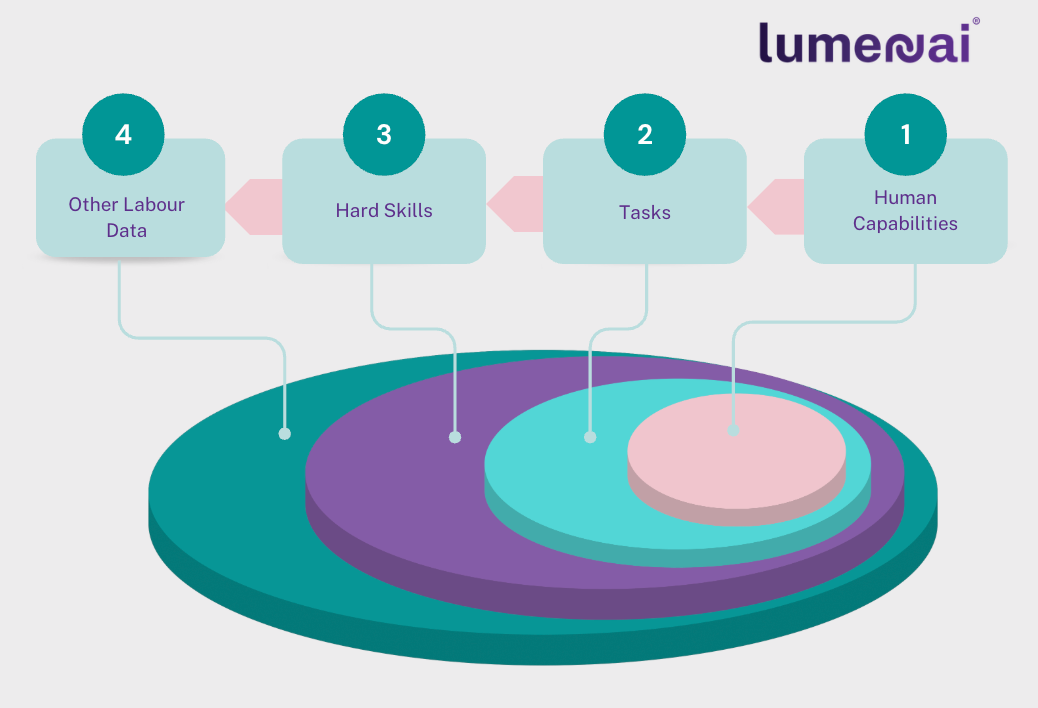
To understand how HCIx Inside functions as an activator, consider workforce intelligence as four interconnected layers:
Layer 1: Human Capabilities (The Core)
The knowledge transfer layer defining how people work. Human capabilities, or Human Skills, are the performance metrics that give you predictive insight into the tasks people complete and the skills and knowledge they need to complete them. Measured across contexts, they become the constant that forecasts performance regardless of role, domain, or technical requirement.
This is the HCIx layer, the DRL 7 foundation everything else depends on.
Layer 2: Tasks
The smaller jobs within a job role. Tasks are the granular units of work into which hard skills are utilised and capabilities become observable performance. They’re the building blocks of roles, the venue where human capability patterns translate into productive output.
Layer 3: Hard Skills
The technical toolkit plugged into task execution. Hard skills are the domain-specific competencies required to execute tasks, the what that gets applied, while human capabilities govern the how.
Layer 4: Other Labour Data
Workforce metrics that gain predictive power when modelled against the HCIx foundation. Tenure, compensation, mobility patterns etc. or all the quantitative People data organisations already collect. Without the capability layer, this data describes the past. With it, this data predicts the future.
The Predictive Logic
Human capabilities, once measured at DRL 7, become the constant in an otherwise variable equation. Because capabilities define how a person approaches work, their knowledge transfer signature, they remain stable even as tasks, roles, and skill requirements shift.
This creates a powerful modelling opportunity.
When you understand someone’s human capability profile, you can predict how they will perform the smaller jobs within any role. The task is the venue; the capability pattern is the performance driver. You can model task fit before deployment, reducing trial-and-error placement.
Learning & Development: Precision Intervention
This framework transforms Learning & Development from generic training catalogues to precision intervention.
When you understand the capability patterns underlying task performance, L&D becomes the expression of granular insight into how capabilities run across tasks and skills. You’re no longer asking “what course should this person take?” You’re asking “which specific human capabilities, developed in which specific ways, will activate skill acquisition and task mastery for this individual?”
That’s a fundamentally different question, and it produces fundamentally different outcomes.
The Integration Reality
Put these layers together, human capabilities at the core, activating tasks, skills, and labour data, and you get an agile AI-enabled workforce intelligence engine. Not a dashboard. Not an analytics suite. A dynamic modelling system that transforms how organisations understand, deploy, and develop their people.
But here’s what matters: this engine only works if your human capability, or human skills, layer is solid.
Without objective measurement, without the development of structured human capability data at DRL 7, you’re running advanced analytics on assumptions. Your tasks work is descriptive. Your skills work is correlational. Your labour data is backward-looking.
DRL 7 HCIx is the foundation layer. Without it, you’re building sophisticated architecture on sand.
Why Speed, Cost, and Portability Matter
We designed HCIx Inside for the operational reality organisations actually face.
Most don’t have years to implement a new measurement paradigm. Most can’t justify prohibitive per-assessment costs across their workforce. Most have already invested in systems and platforms they need to keep using.
HCIx Inside addresses the following constraints:
Rapid deployment: Capability measurement that integrates into existing workflows without friction, delivering structured DRL 7 data in hours and weeks rather than years.
Cost efficiency: democratising access to structured human data so it’s not reserved for executive hires or high-stakes roles, but available across the workforce where predictive insight actually drives value.
System-agnostic portability: People data structured for export and import into any system, activating your existing investments rather than replacing them.
This isn’t about buying another platform. It’s about installing the DRL 7 foundation layer, or putting the HCIx Inside, that makes your existing platforms intelligent.
The Bottom Line
The WEF is right: human-centric skills are the foundation of future growth. But recognising their value isn’t the same as capturing their ROI.
Human capability measurement at DRL 7 is the unlock. It’s what transforms tasks taxonomies from descriptive catalogues into predictive frameworks. It’s what transforms skills ontologies from static inventories into dynamic matching engines. It’s what transforms labour data from historical record into forward-looking intelligence.
HCIx Inside exists to provide that unlock, fast, affordable, portable. The DRL 7 foundation layer that activates everything above it.
If you’re building workforce intelligence capabilities, the question isn’t whether you need structured human capability data. The question is whether you’re going to get it before or after you’ve discovered your existing investments can’t deliver the ROI you expected.
Next Steps:
Join our weekly DRL 7 Use Case workshops. Whether you’re interested in building a use case with HCIx or exploring any other area of People data, we’re running free weekly workshop sessions to help you develop a DRL 7 use case at whatever pace suits you. These sessions are designed to build awareness and understanding of the shape of this problem and what solutions are being brought forward in rigorous and transparent ways under the Data Maturity Matters academic methodologies, toolkits and standards frameworks.
On 20th January 2026, we kick off with a deep dive into Data Readiness Levels, exploring the nine-level framework, what DRL 7 means in practice, and how to identify a business pain point suitable for use case development. From there, participants will work through a structured programme to formalise their challenge into documented use case format, connect with organisational partners who can provide evidence, and prepare for submission in our academic paper that is the foundation work of Data Maturity Matters.
You can join as a use case provider bringing a business pain point to formalise, or as an organisational partner providing evidence for use cases that will be submitted in academic papers. Either way, you’ll be contributing to the growing body of validated research on people data maturity.
Find out more about the workshops and webinars programme:
https://www.datamaturitymatters.tech/webinars-and-working-parties
Register your interest for the programme: https://www.datamaturitymatters.tech/bookyourplace
For direct HCIx implementation pathways: www.lumenai.tech
Or contact me directly: antonia@lumenai.tech