
The Data Readiness Level (DRL) 7 Breakthrough
The critical transformation from People-data-as-a-technology-by-product to People-data-as-a-strategic product

The People Data Architecture Problem
Our Data Readiness Levels (DRL) methodology reveals a fundamental challenge facing organisations pursuing robust Predictive People Analytics and AI enablement: there is a significant risk of a Data Readiness Level (DRL) 5-6 plateau where organisations implement increasingly sophisticated analytics capabilities whilst maintaining reactive collection architectures designed for Industry 3.0-4.0 operational efficiency.
This creates an People data architectural mismatch, where organisations attempting to achieve robust Predictive People Analytics are held back by using People data collection systems designed for previous industrial paradigms. No matter how sophisticated your AI capabilities become, they cannot overcome the limitations of People data that was never designed for intelligent consumption in the first place.
Data Readiness Level (DRL) 7 represents the critical breakthrough that resolves this mismatch through a fundamental People data architectural revolution: the transition from People data as technology by-product to People data as a strategic product.
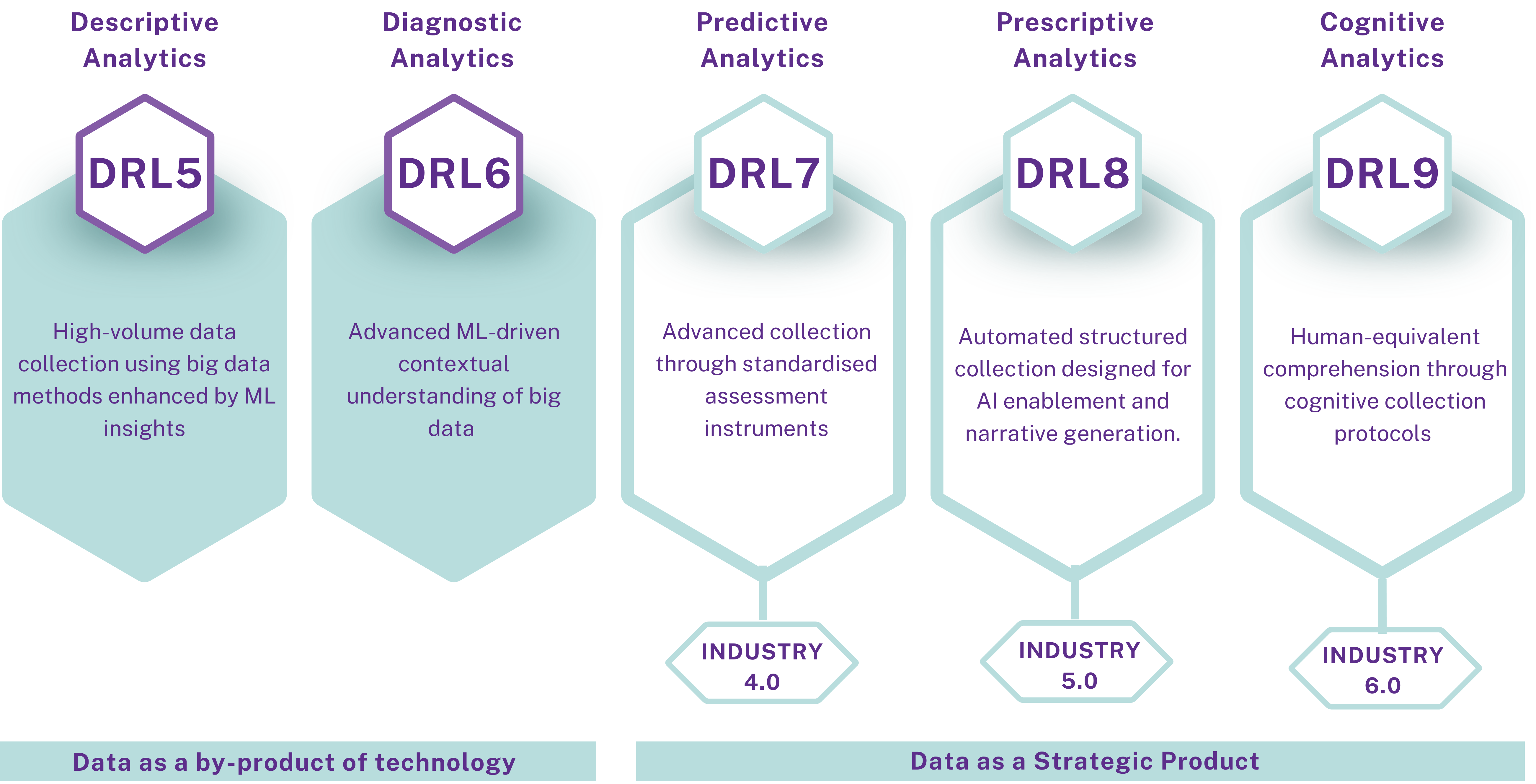
Data Readiness Level (DRL) 6: The Sophistication Plateau
At Data Readiness Level (DRL) 6, we see the application of sophisticated data science and machine learning techniques to People data that was originally collected as operational byproducts. This includes two main categories:
Traditional numerical operational data: salary figures, tenure data, training completion rates, basic performance scores, or put more simply, structured People data.
Big data scraped from technological interactions: email metadata (communication frequency, response times, network patterns), system login data (usage frequency and duration), collaboration tool usage and digital behavioural traces from all workplace technology interactions. This big data approach works reasonably well for processing numerical behavioural indicators because, again, it is structured data.
Organisations can identify sophisticated patterns in both operational metrics and digital behaviour, applying advanced machine learning to this combination of numerical operational by-products and scraped data. They can tell you exactly how many emails someone sends, how often they use different systems, what their salary progression looks like, and how they score on basic performance metrics.
The real issue is with qualitative behavioural data. While organisations have impressive data science capabilities for processing both traditional numerical data and big data from technological interactions, when it comes to the qualitative behavioural intelligence that explains why these patterns occur and what they actually mean for performance, there’s little or no structured approach to the People data collection.
The fundamental challenge is that performance data (the actual backbone of Predictive People Analytics) is typically captured through subjective manager assessments, 360s or surveys that are in narrative formats that resist systematic analysis. This forces organisations to rely heavily on easily quantifiable but often meaningless numerical proxies and digital behavioural traces that lack meaningful connection to actual performance outcomes. The result is what appears to be sophisticated Predictive People Analytics but what is actually performative analytics using numerical data and big data that doesn’t translate into robust transformation initiatives or yield the ROI that organisations expect.
Robust, or mature, Predictive People Analytics requires objectively collected People data that demonstrates the actual value of performance across human values, behaviours and decision making factors. Without systematic approaches to capturing this data as a strategic product designed specifically for analytical consumption, organisations cannot progress beyond Data Readiness Level (DRL) 6.
The result is that organisations have substantial numerical data about easily measurable activities and subjective performance opinions trapped in unstructured formats, but lack the structured behavioural and performance intelligence that would enable genuine prediction of future outcomes and identification of transformation opportunities.
Yet despite this technological sophistication, Data Readiness Level (DRL) 6 still operates on the fundamental limitation that characterises all previous levels: treating People data as operational by-products extracted from systems designed for operational efficiency rather than analytical intelligence.
Data Readiness Level (DRL) 7: The Architectural Revolution
Data Readiness Level (DRL) 7 represents the breakthrough that moves organisations from Diagnostic Analytics to robust Predictive People Analytics and AI enabled Workforce Intelligence.
The critical transformation occurs across six dimensions:
People Data Collection: Advanced collection through standardised assessment instruments that are purpose-built for analytical consumption rather than operational convenience. Instead of extracting insights from systems designed for payroll or compliance, organisations implement collection methods specifically engineered to capture the data needed for Predictive People Analytics and AI enablement.
Standardisation Protocols: The breakthrough element where evolving standards enable People data to become a strategic business asset rather than operational byproduct. This moves beyond static compliance frameworks to dynamic standardisation that adapts based on analytical requirements rather than administrative needs.
Quantitative Data: Structured machine learning on real-time numerical performance metrics that go beyond basic operational data. Rather than relying on attendance rates and system usage statistics, organisations capture meaningful numerical indicators that support predictive modelling.
Qualitative Data: Structured performance assessments that objectively capture human factors in machine-learning-ready formats. This represents the critical shift from subjective narrative performance reviews to systematic assessment protocols that preserve human nuance whilst enabling algorithmic analysis.
Analytics: Mature Predictive People Analytics capabilities that move beyond the diagnostic “what happened” analysis to Predictive “what will happen” insights, across strategically collected quantitative and qualitative People data, that enable proactive intervention and strategic planning.
Impact: Complete AI enabled Workforce Intelligence that effortlessly transforms People data into strategic competitive advantage rather than operational efficiency reporting, enabling organisations to make genuinely informed decisions about human capability and performance.
The Implementation Challenge
The technical specifications for Data Readiness Level (DRL) 7 are clear: advanced collection through standardised assessment instruments, evolving standards enabling People data as strategic business asset and structured advanced behavioural and values assessments that enable complete Predictive People Analytics and AI enabled Workforce Intelligence. However, the practical question facing organisations is: how do you implement these People data architectural transformations?
How do you transition from reactive extraction of operational People data by-products to the proactive engineering of strategic People data assets designed specifically for intelligent consumption? How do you build collection systems that capture structured behavioural People data in formats ready for machine learning analysis whilst maintaining human nuance? How do you create direct pipelines from People data collection to Predictive People Analytics capabilities without the quality degradation that characterises traditional extraction, transformation, and loading processes?
The Path Forward: Data Readiness Level (DRL) 7 represents not just a technical milestone, but the foundational architecture required for organisations seeking to achieve Industry 5.0 and 6.0 and the competitive positioning of robust Predictive People Analytics and AI enablement in an increasingly intelligence-driven competitive landscape.
The framework is established, the architectural requirements are identified, and the theoretical foundation is solid. But moving from theory to operational reality requires practical implementation methodologies that transform these architectural specifications into working systems.
Our next post will examine how these theoretical Data Readiness Level (DRL) 7 frameworks can translate into operational reality, specifically, how organisations can implement purpose-built collection systems that capture structured behavioural People data and create direct predictive integration without technical disruption to existing operations.
For more information or to access our free open-source Data Readiness Levels (DRL) frameworks and toolboxes and/or to contribute your voice and expertise to the evolution of this work please visit: www.datamaturitymatters.tech